The Protestant Orphan Asylum
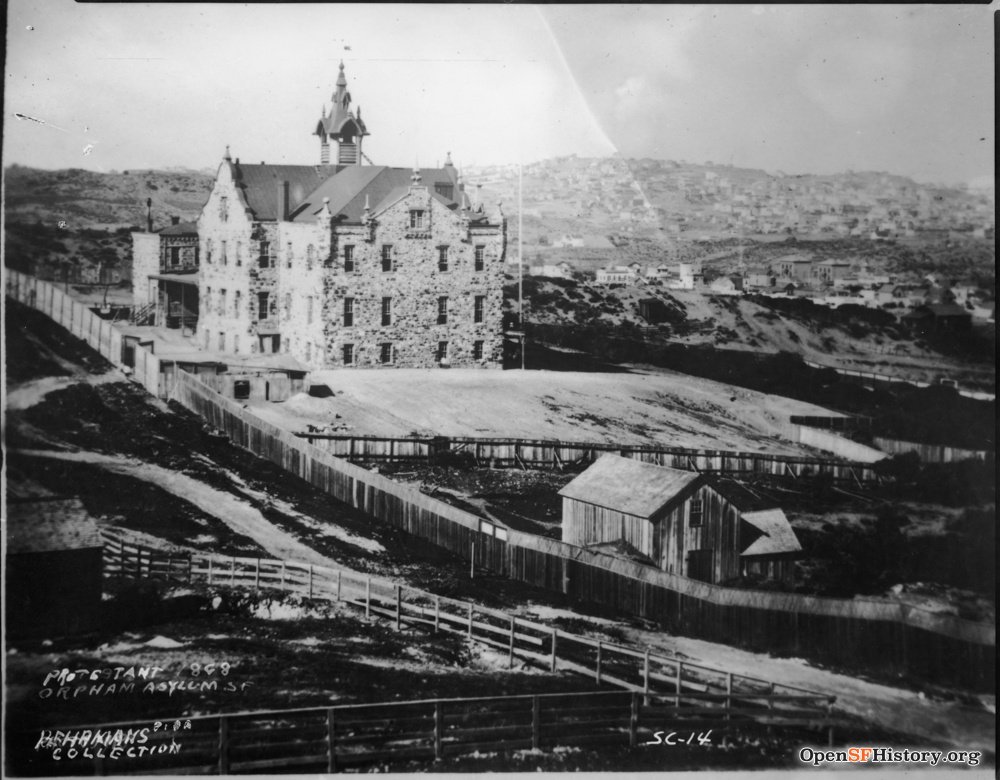
Protestant Orphan Asylum, 1868—View northeast from Hermann, fence line along Buchanan. (OpenSFHistory / wnp71.1633)
Before the mint, there was an asylum. During the gold-rush years of the 1850s, this neighborhood was a remote suburb of San Francisco, ideal for purchasing cheap land. It would take decades before even Market Street extended this far inland.
In 1851, a group of Protestant women started the San Francisco Orphan Asylum Society (SFOA), which opened their first orphanage on Folsom Street in Happy Valley, an area south of Market Street near Rincon Hill. Needing to expand their facility, the SFOA raised money to purchase the two blocks bound between Haight to Hermann (north to south) and Laguna to Buchanan (east to west) for $100 in a public auction, c. 1853. George Gomes recounts that the orphanage was built of stone, which was quarried from the nearby site called “Rock Hill,” where the Spring Valley Water Company operated a reservoir—and where the U.S. Mint would eventually call home. The Water Company transported the stone free of charge. The first 30 children moved into the orphanage in 1854 and the SFOA became known as the SFPOA (San Francisco Protestant Orphan Asylum).
As Woody LaBounty reports, the SFPOA founders, board of managers, and staff were all women for over a century. The mission of the staff and its guiding board was not only to feed, clothe, and shelter the orphanage residents, but also to instill Protestant ethics and morality. The orphanage officially accepted only white, Protestant boys and girls between six and twelve years of age. In its early years the institution rejected children of parents believed to lead “immoral” lives, no matter how dire the need (LaBounty). Despite these restrictions, the SFPOA served over 3,500 children in its first fifty years of existence and could house up to 300 children. LaBounty explains, “In addition to housing youth in need, the organization placed children in adoptions or indentured work and followed up on these placements yearly. Children received training in carpentry and other job skills, and as they aged out of the orphanage at 17, many of the wards were given seed money to embark on a trade such as dressmaking.” “The site would remain home for the orphanage from 1854 to 1919. San Francisco legend has it that Haight and Waller Streets were named after Mrs. Haight and Mrs. Waller, who served on the SFOA Board” (Gomes). The list of donors to the Asylum would eventually include a who’s-who of San Franciscan society: Bancroft, Coit, Crocker, Flood, Phelan, Stanford, Levi Strauss, and Sutro (Gomes).
By the end of the 1800s, Market Street extended as far as Duboce Street, where Rock Hill stood in the way. “That hill blocked Market from being a straight and level boulevard to Castro Street” (Anderson). Notice that Rock Hill was a 210-foot high rock in 1857 (see map below). The rock blocked westward development until the city of San Francisco decided to cut through it to make the “Market cut” and the “Duboce cut” (Ness). After the 1906 earthquake, because this part of the city was not destroyed, the Army set up their control center with food distribution for refugees on the Duboce cut, conveniently close to the Spring Valley Water Company reservoir nearby. In the photos of the Duboce cut below, you can see the south part of the mound on the left and the north part on the right (Anderson).
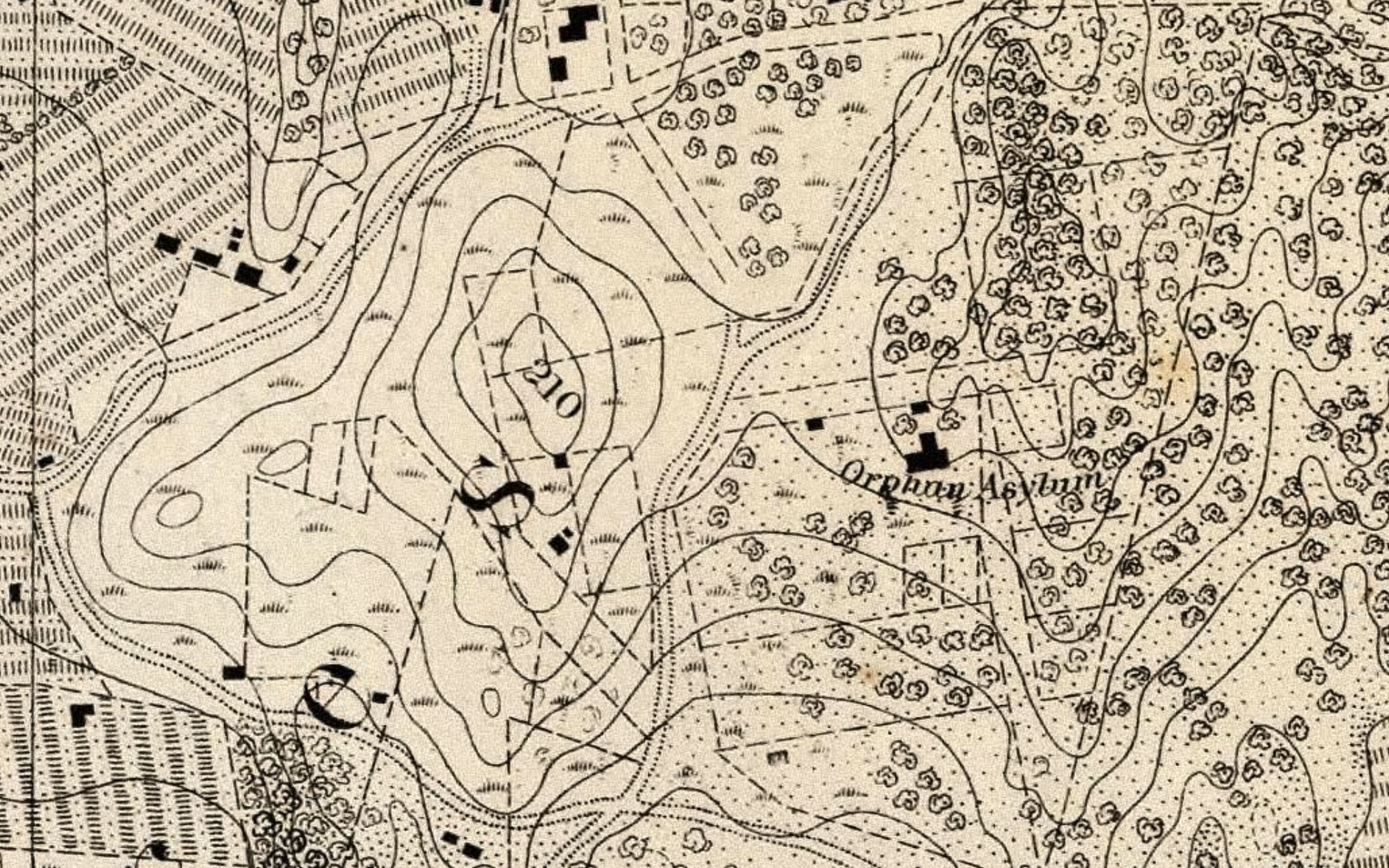
The Clinton Mound (Rock Hill)—A 210-foot rock directly south (to the left) of the orphanage. (1857 U.S. Coastal Survey)
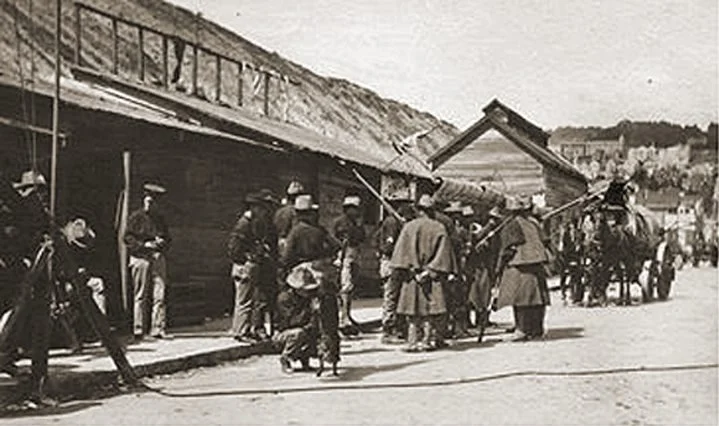
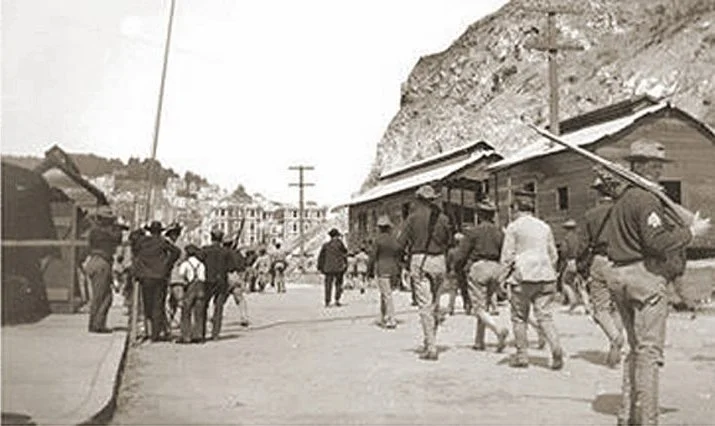
Many of the parcels in the neighborhood around Duboce Avenue were undeveloped and refugees from the 1906 earthquake erected tents on the empty lots, in proximity to the Army’s aid center. The Orphan Asylum survived the earthquake with significant but repairable damage. However, the condition of the aging structure and the changing model of care for children inspired a relocation plan a few years later (LaBounty). In the 1920s, the property was sold to the State of California, which had been leasing part of it for a teacher's college since 1905 (LaBounty). After a temporary relocation to the Richmond District, the Orphan Asylum bought ten acres of land along Vicente Street between 28th and 30th Avenue in the Parkside District in 1923 and opened a new campus there in 1924 (LaBounty). It is now known as Edgewood (formerly the Edgewood Center for Children and Families). Soon after the relocation of the orphanage, a new teacher’s college was built on the former site, along with the construction of neighboring apartment buildings in the Art Deco style.
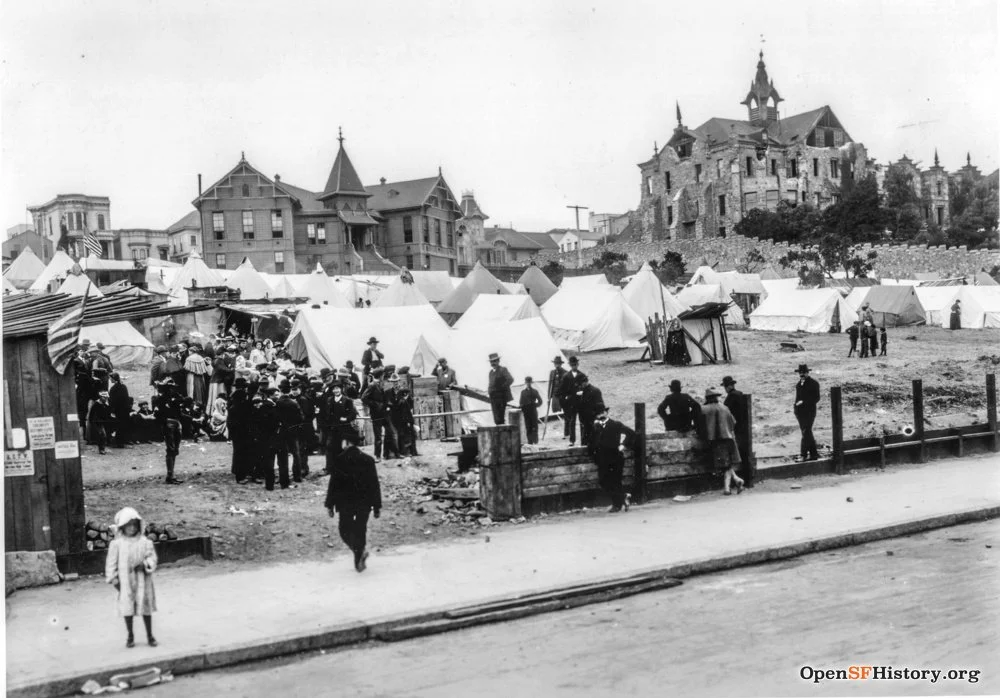
Earthquake refugees, 1906—View northwest from Laguna, Protestant Orphan Asylum in background, right. (OpenSFHistory / wnp4.1573)
Also in the 1920s, the rest of Rock Hill south of Duboce Avenue, which became known as “the Clinton Mound,” was completely leveled, leaving the mound to the north that would later become the base of the U.S. Mint. The current-day neighborhood of “Mint Hill” would earn its name from the U.S. Mint when it opened in 1937.
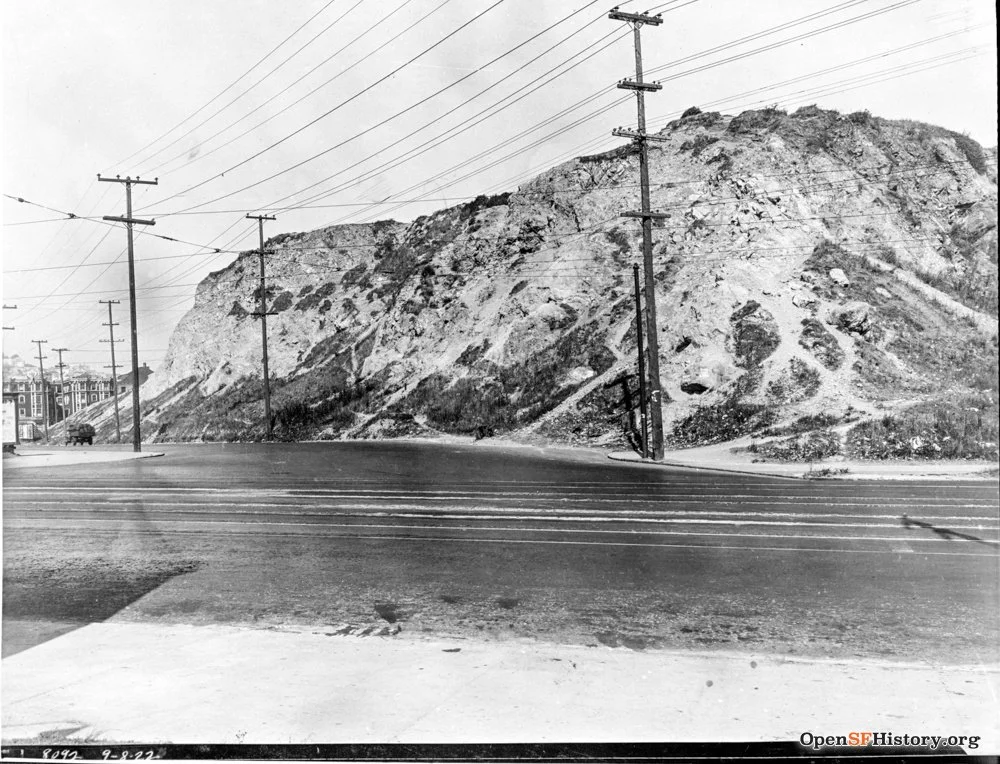
The Clinton Mound, 1922—View northwest toward Duboce, apartments at Church and Duboce visible in background left. (OpenSFHistory / wnp36.02908)
The neighborhood follows the natural topography formed by the serpentine rock formation under the mint. The hill rises from Octavia in the east, past the crestline along Buchanan, down to Webster in the west. It also rises from Duboce Ave in the south, up the crestline of Buchanan, to Haight Street in the north. If you follow Webster, Buchanan, or Laguna Streets north over the hill, you end up in a valley called Hayes Valley, running down along Hayes Street.
Citations
Anderson, R Christian. “Market Street’s original path was blocked by the Mint Hill mound.” Facebook, Market Street Railway-San Francisco, 4 May 2020, https://www.facebook.com/groups/marketstreetrailway/posts/10158064654434088/. Accessed 10 November 2025.
Gomes, George. “San Francisco Orphan Asylum Society.” FoundSF, https://www.foundsf.org/San_Francisco_Orphan_Asylum_Society#:~:text=Back%20to%20the%20hill%20at,in%20the%20teens%20and%20twenties. Accessed 10 November 2025.
LaBounty, Woody. “Edgewood (formerly the San Francisco Protestant Orphanage).” Outsidelands.org, 21 April 2011, https://www.outsidelands.org/edgewood.php. Accessed 13 November 2025.
Ness, Stephen A. “Protestant Orphan Asylum.” Ness Software, 11 August, 2025, https://www.nesssoftware.com/www/sf/asylum.php#:~:text=Mint%20Hill%201906%20contains%20more,until%20its%20demolition%20in%201919. Accessed 10 November 2025.